
Everything you need to specify stone
Samples, technical data sheets, textures and help with specification. We help preserve the design intent at the procurement stage, when material is most often replaced with an "equivalent".
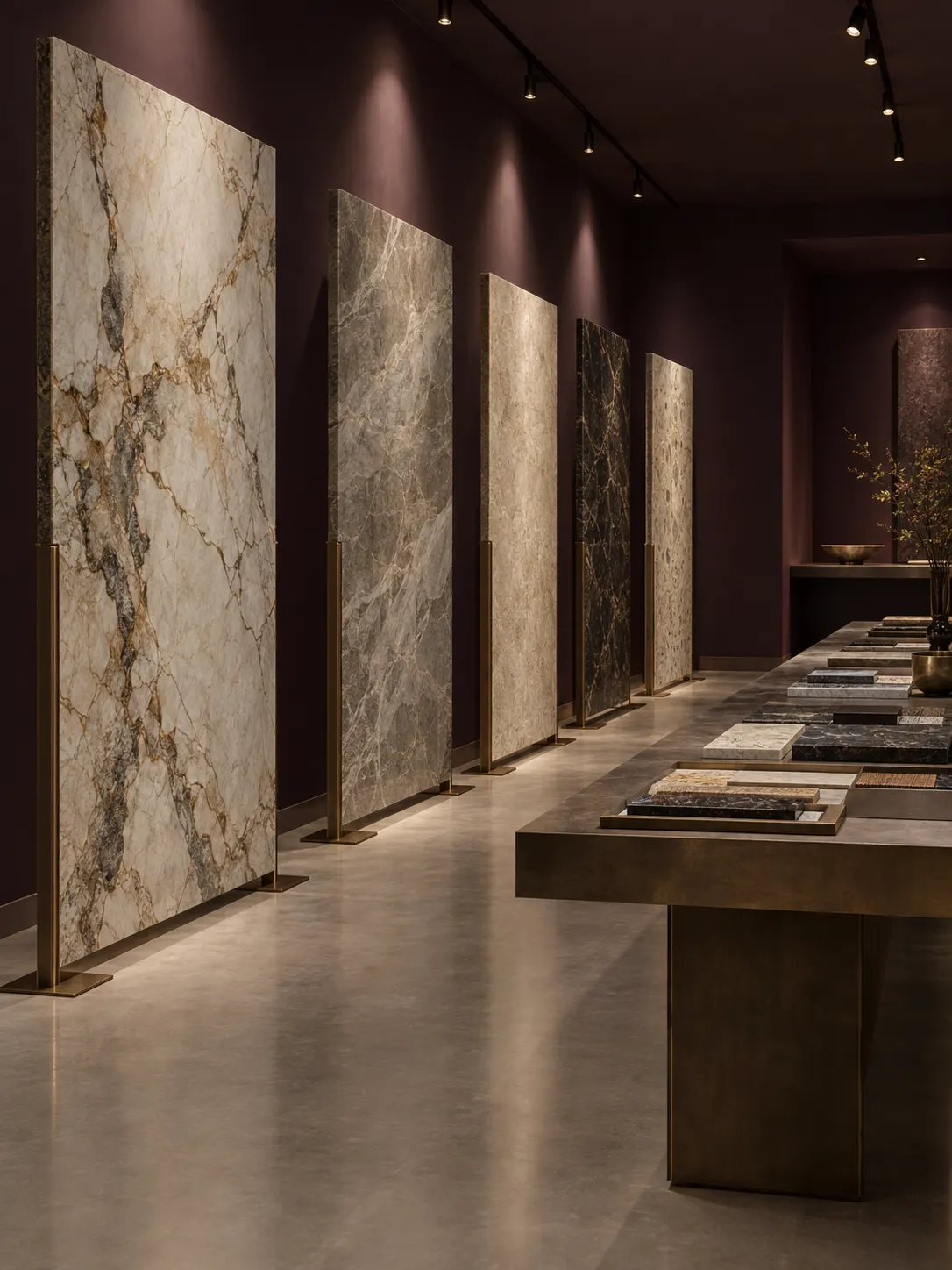
Samples and data for your project
For architecture and interior design firms working on projects with large-format slabs.
ARTEFACT Surfaces Catalog 2026
PDF catalog for design firms and clients: 46 designs from the ETRUSCO, GEMMA and MATERIA collections with formats, thicknesses, surfaces and application scenes.
Sample kits
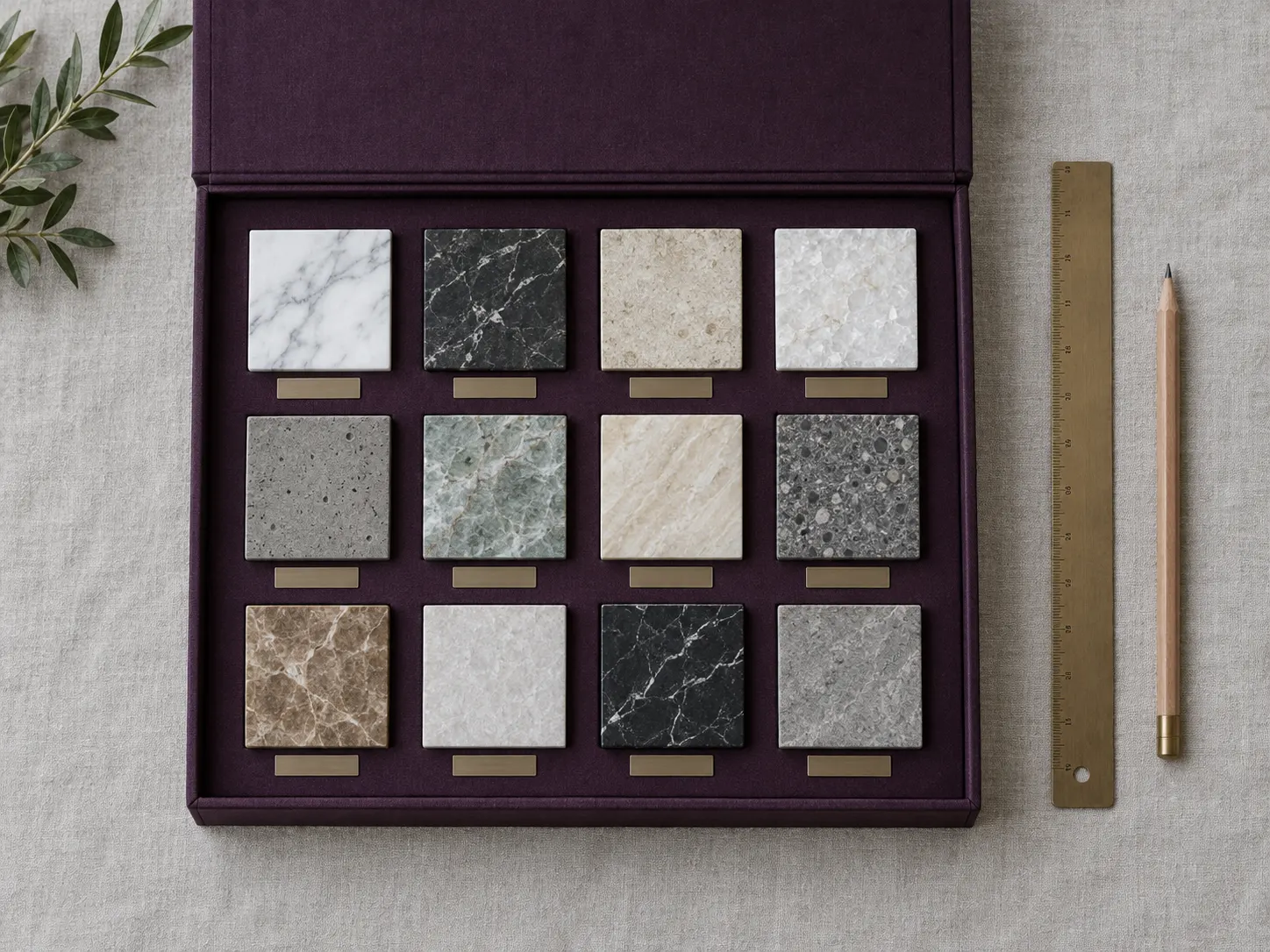
A box of samples of key designs from all three collections for your firm's material library. Each sample has a QR code linking to its technical data sheet.
Technical data sheets
Parameters of a specific product: geometry, mechanics, surface, slip resistance, processing and traceability.
Textures and BIM/CAD
High-resolution textures for visualisations and BIM/CAD materials — on request for your project.
Presentations at your office
We come to your office with full-size samples and explain the material, processing and limits of large formats in 45 minutes.
How many slabs you need
A quick estimate for a preliminary specification. We calculate the exact quantity from the layout, taking into account pattern, cut-outs and cutting.
Weight is approximate, based on a density of about 2.45 g/cm³. Weight and rack capacity are confirmed by the factory specification and packing scheme.
What to know about sintered stone
Short answers to the questions architects and contractors ask most often at the design stage.
How is sintered stone different from porcelain stoneware?
Both are ceramics, but sintered stone is pressed into large formats and fired at a higher temperature. The result is a dense slab with minimal water absorption that can be cut into countertops, steps and furniture fronts.
For a project, the name matters less than the figures of the specific product in its technical data sheet: thickness, flexural strength, slip resistance and geometric tolerances.
What thickness should I choose for a countertop?
For countertops and kitchen islands the main catalog thickness is 12 mm: it is available for most designs in the 1600×3200 format. 9 mm suits countertops on a substrate, furniture, walls and floors.
20 mm is for solid countertops and paving, available for selected MATERIA designs on request. 6 mm is for wall cladding, furniture fronts, doors and ventilated facades.
Which slab formats are in the catalog?
The main format is 1600×3200 mm (5.12 m²), available in all three collections. Selected designs are also available in 1200×2700, 1200×2400 and 900×1800 mm; metal designs of MATERIA also in 1200×3600 and 1500×3000 mm.
Available formats and thicknesses are listed on each design page and confirmed when ordering.
What are faces and book-match?
Faces are several pattern variations of one design: on a large wall the pattern continues without visible repeats. Book-match is a mirrored layout of adjacent slabs where the veins form a symmetrical panel.
We plan the required layout in the schedule in advance — it determines the number of slabs and the order in which they are selected at the factory.
Can large formats be used in wet areas?
Yes, 1600×3200 slabs work well in showers: fewer joints mean fewer places for dirt to collect. For floors, choose a surface with a confirmed slip resistance rating — by test method, not by the word "matt".
Waterproofing, falls and substrate are done by the contractor according to the design; we provide the layout and substrate requirements.
How are large slabs supported and installed?
1600×3200 mm slabs require a level substrate, large-format adhesive, full-coverage application and installation with vacuum lifters. Transport and lifting are vertical only, on A-frame racks.
We arrange interior installation by partner crews with proven large-format experience and a test installation before going on site.
How do you check a batch before shipment?
Before ordering, we agree on a surface reference sample, colour and acceptable variation. Before shipment, we inspect geometry, flatness, edges, pattern, packaging and batch labelling.
Each batch gets a code linked to the reference sample, so additional material can be supplied later without shade mismatch.
How much does the material cost and what does the price depend on?
We calculate the price for each project: it depends on the design, thickness, volume, processing, logistics and import duties. Our calculation shows the full delivered cost to site, not just the factory price.
For an estimate, send us the areas and square metres — we will prepare a comparison of 2–3 options.
Factory visits in China
For firms we work with on projects, we organise visits to factories in Guangzhou: production, processing, slab selection and approval of reference samples on site.
Working on a large-format project?
Send us the project stage and application areas — we will prepare samples and data sheets for your design.